


PV record in Bulgaria 2025
More than 63% power
 Roman Rubanovich
Today is 19 May 2025, Monday. In Bulgaria it is sunny and cool — ideal conditions for photovoltaic systems. At noon, many of them operate at full power or even slightly exceed their rated values if all solar modules are oriented to the south.
In most cases, what matters more than peak power is the uniformity of solar generation throughout the day, so we usually install at least two groups of PV modules, placing them at different azimuths.
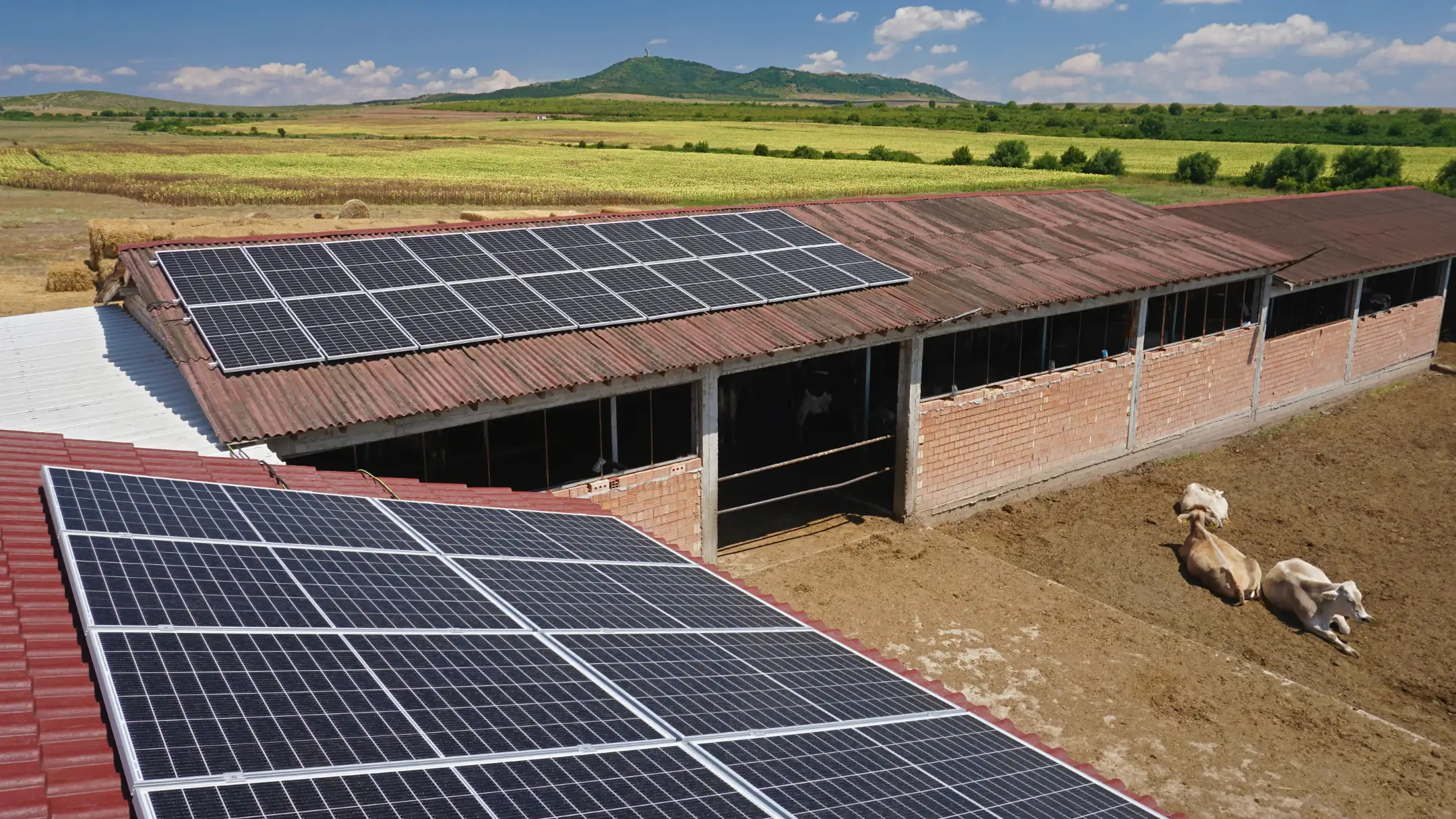
We applied the same approach when building an autonomous photovoltaic system for a cow farm in 2020: 12 modules face southeast, and another 20 — southwest. As a result, one group reaches its maximum before noon, and the other — after.
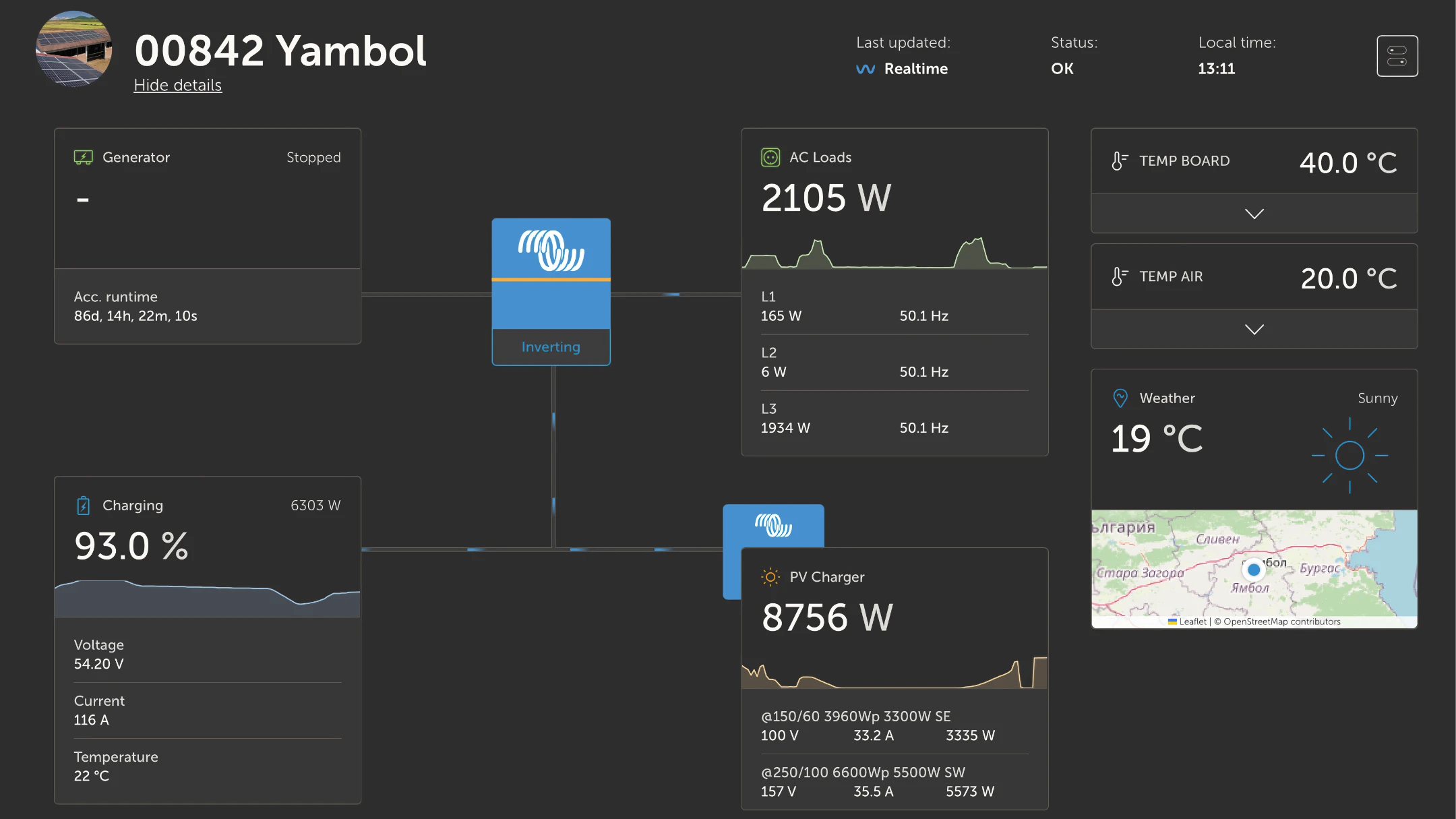
For five years now, this system has been operating reliably, providing autonomous power supply to three-phase loads during the morning and evening milking of cows, and to single-phase loads — around the clock. Today at noon, despite the different azimuths, the system was delivering PV power close to its maximum, which, although it happens rarely, is not in itself anything unusual.
However, as the number of photovoltaic systems continues to grow day by day, something unusual happened today. For the first time in Bulgaria’s history, the share of PV generation exceeded 60 % in the overall mix, remaining at this level for about an hour.
At a certain moment, the share of photovoltaic generation reached a staggering 63.73 %, delivering 3.63 GW and exceeding the current power of the nuclear power plant by 3.65 times, which at that moment ranked second in the overall generation mix:
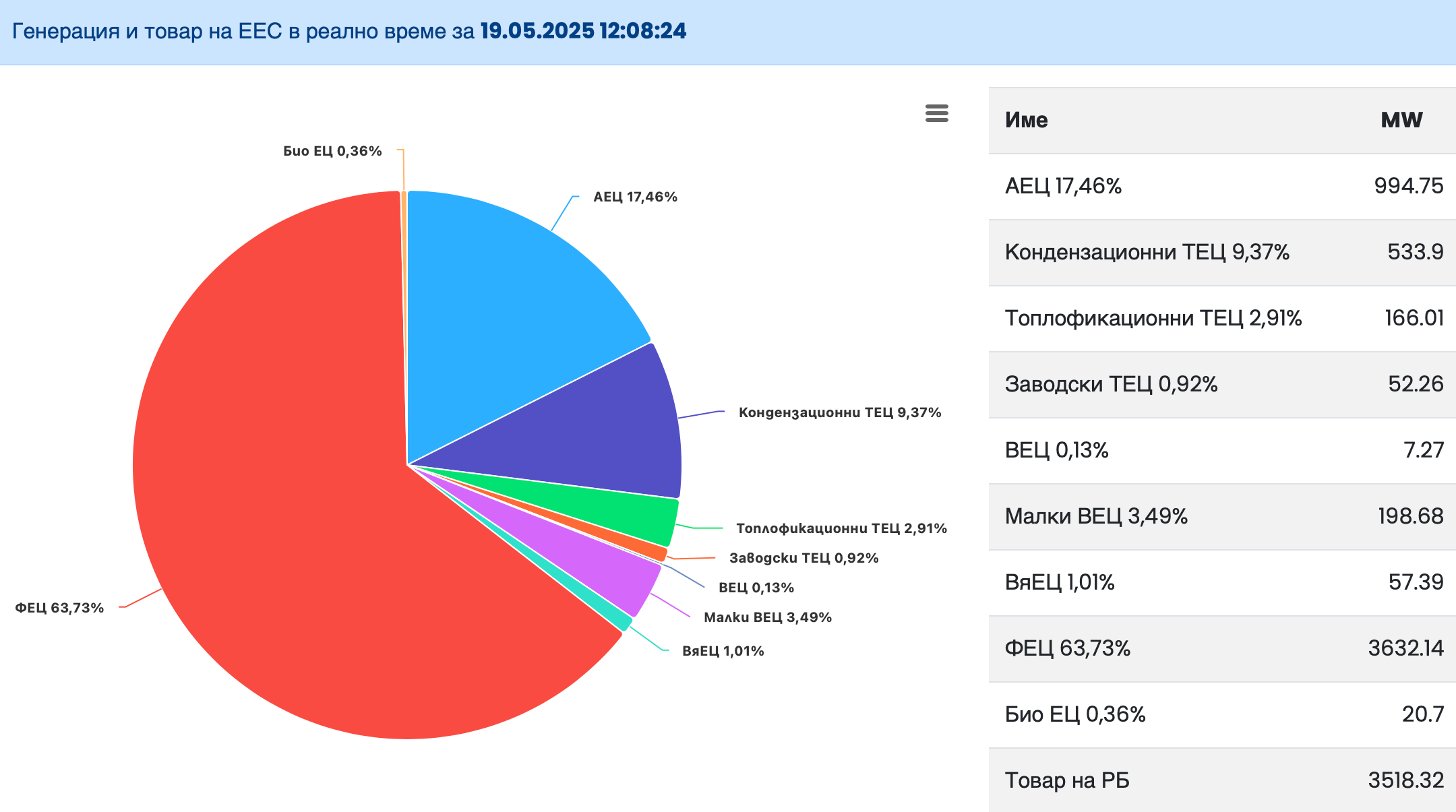
Even more surprising is the fact that at that moment solar generation by 3.3 % exceeded current electricity consumption (3.52 GW). Conditionally speaking, at noon solar generation in Bulgaria covered the country’s electricity needs by 103 %.
In fact, even more
At the beginning of the article, I deliberately mentioned a small PV system that we built for a Bulgarian farm. Today at noon, it was operating close to full power, covering current consumption and charging the batteries for the evening milking of cows. However, the output of this system is not included in the overall generation statistics.
Most PV systems that we design and build are intended specifically for self-consumption rather than for selling energy to the grid. These include systems for private houses, factories, offices, farms, warehouses, and even ships. Among them are large and small, off-grid and grid-connected, hybrid and mobile systems. All of them were operating today at power levels close to their maximum, yet they were not included in the overall statistics.
How many such systems there are across Bulgaria today is difficult to say. Probably tens of thousands. Therefore, the actual share of PV generation at noon today certainly exceeded 70 % of the overall mix, and perhaps even 80 % — it is not possible to verify this.
❗On the one hand, such a high share of PV generation is very impressive. On the other — the transformation of the energy sector is happening, possibly, too fast and not always in the right way, creating potential risks.
Exactly three weeks ago, on 28 April 2025 (Monday), at 12:33 Central European Summer Time, a failure occurred in Spain’s power system, leading to a large-scale power outage across the Iberian Peninsula. In most affected areas, electricity supply was restored after approximately ten hours, although in some locations disruptions persisted longer. The share of PV generation in Spain at the time of the incident was 56.6 % (16.5 GW).
It is precisely the high share of renewable energy sources in general, and photovoltaic generation in particular, that many point to as the cause of the blackout in Spain. However, I would not rush to conclusions before the investigation of the incident is completed and the official report is published.
In my view, the share of PV generation worldwide will continue to grow further, at times slowing down and at times accelerating. I believe that in 20-40 years, with sufficient development of energy storage systems, solar generation will become the main source of electrical energy for humanity.
See also:
03.07.202512.07.2025
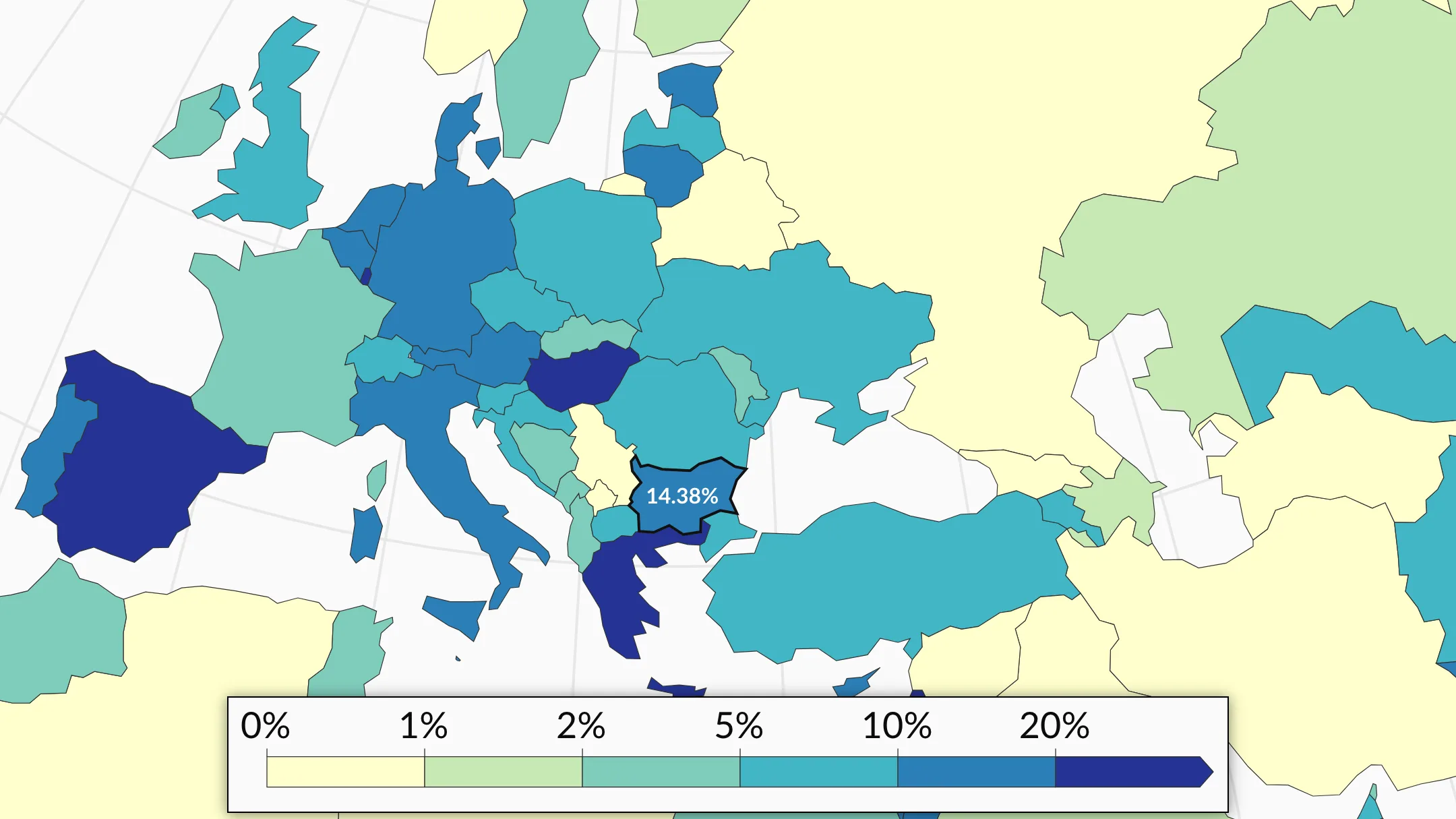
PV share in Bulgaria 2024Data for 2024 has been published, showing that the share of solar (in our case, photovoltaic) generation in Bulgaria has increased nearly ...
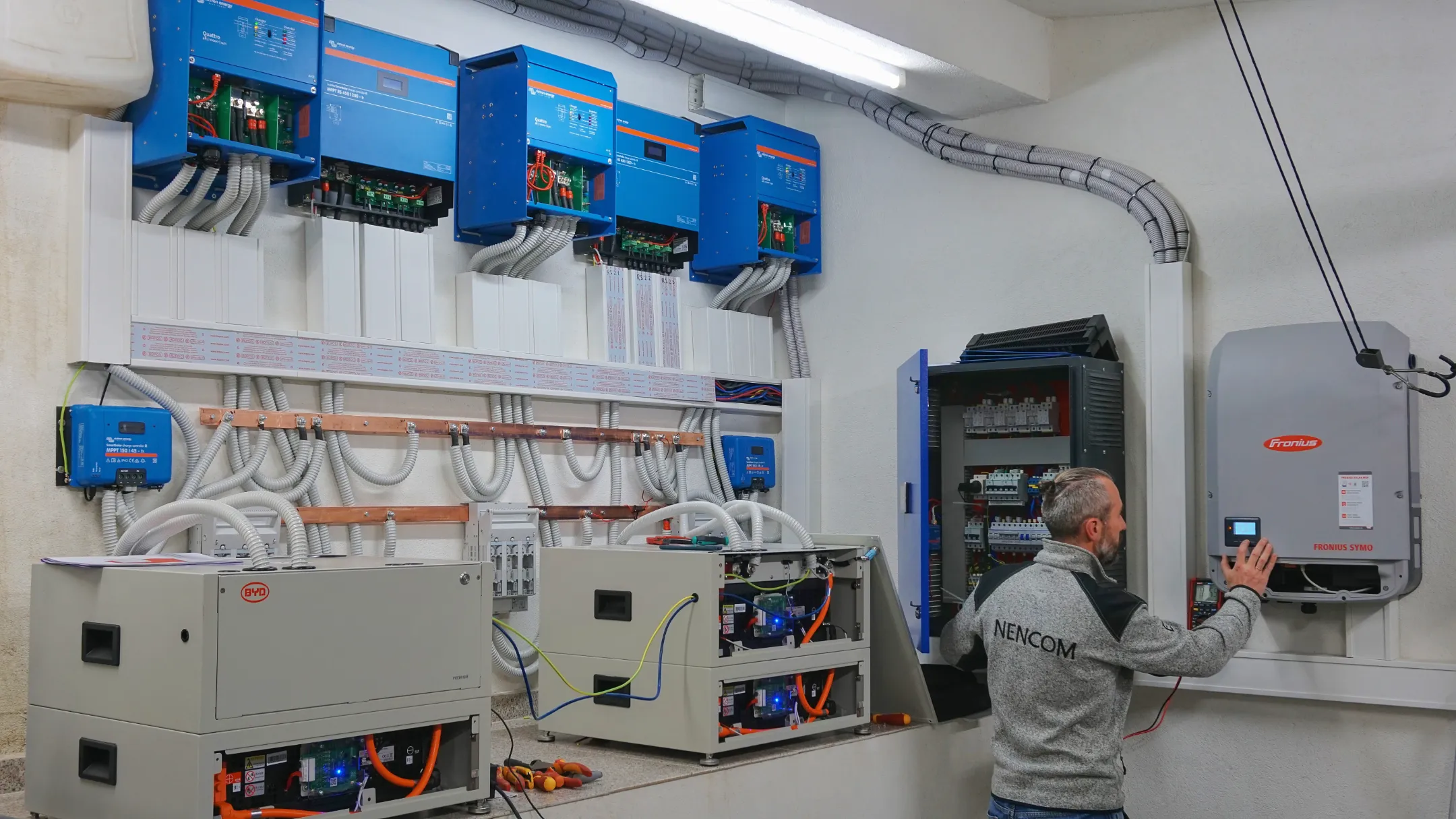
If you are planning an investment in a solar project or simply want to understand the principles of photovoltaic and ...