


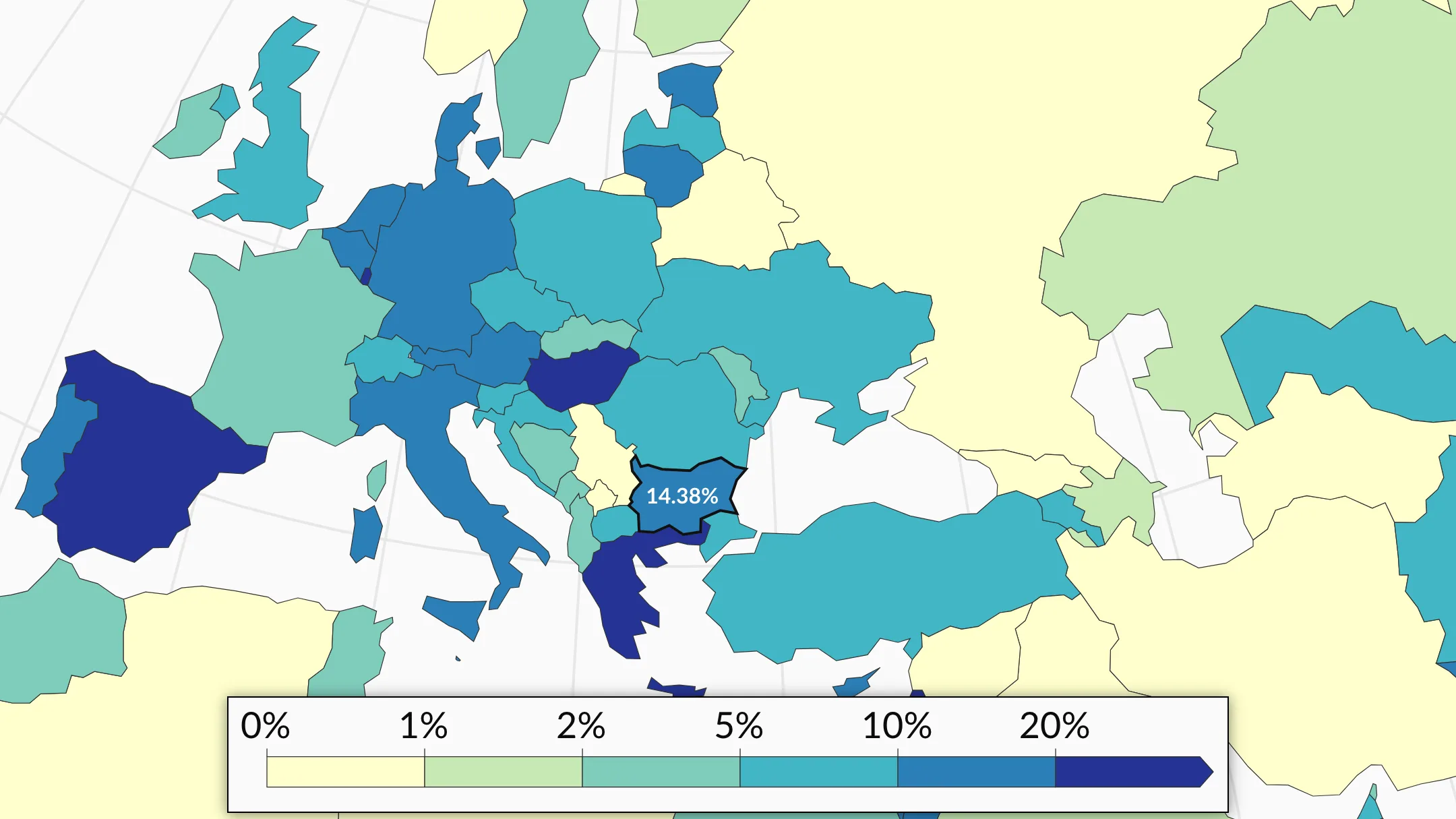
PV share in Bulgaria 2024
Generation up 3.5×
 Roman Rubanovich
Data for 2024 has been published, showing that the share of solar (in our case, photovoltaic) generation in Bulgaria has increased nearly 3.5 times over two years:
| Year | Energy, TW·h | Share, % |
| 2022 | 2.09 |
4.16 |
| 2023 | 3.52 | 8.78 |
| 2024 | 5.34 | 14.38 |
The actual share of solar generation is even higher, as there are a large number of private PV systems «for own consumption» whose production is not reflected in the official statistics.
Over the same period, the share of coal generation has been halved:
| Year | Energy, TW·h | Share, % |
| 2022 | 21.79 |
43.34 |
| 2023 | 11.73 | 29.24 |
| 2024 | 8.01 | 21.57 |
There have been no significant changes in the other sources of generation.
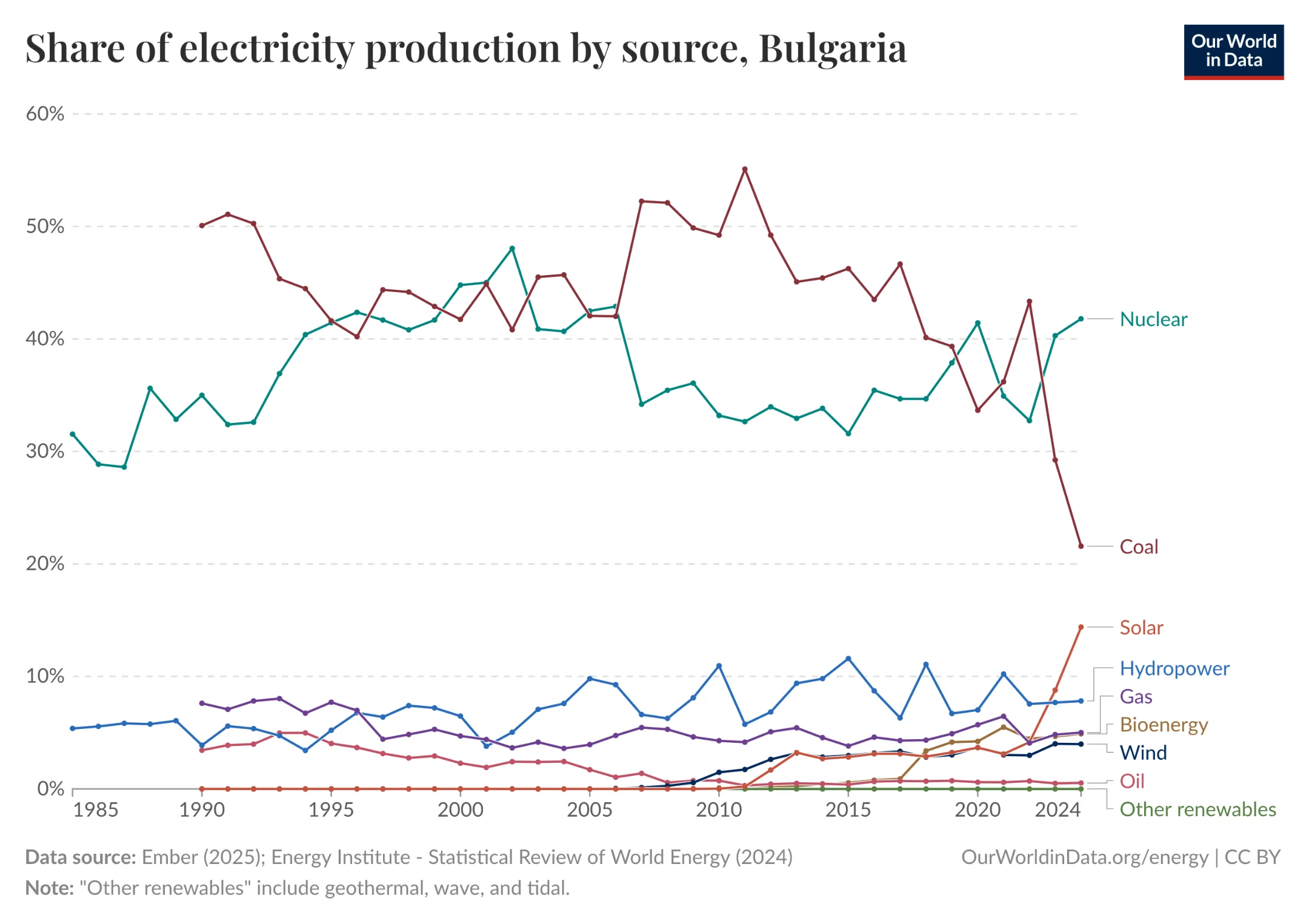
It is clear that solar generation will continue to displace coal, reducing electricity production costs and making the air cleaner. However, two key problems arise.
The first is the unevenness of solar generation. At midday on sunny days, production exceeds demand, electricity market prices drop to zero or even become negative, and owners of PV power plants incur losses. In the evening, during peak demand — PV generation is already gone. This problem is addressed through the development of energy storage systems (ESS). Battery storage systems are already being actively deployed across the country, so the shift of surplus midday generation to the evening peak will become noticeable within the next 1-2 years. The restoration of the pumped storage hydropower plant «Chaira» has also finally begun. This is the largest PSH plant in the Balkans (essentially — a massive gravity battery), which was damaged in March 2022 under not fully clarified circumstances. One of the four units has already been restored and is operational; two more may be restarted next year. Plans for the construction of new PSH plants in Bulgaria are also under discussion, so the problem of daily fluctuations between generation and demand has a technical solution.
The second problem is the low inertia of solar generation, which reduces the stability of the power system under adverse conditions or control errors. Ordinary PV inverters do not form the grid — they merely follow it, adding their power to the overall mix. In addition, unlike conventional synchronous generators, standard PV inverters do not produce reactive power and do not possess mechanical inertia from a rotating mass — both of which are critical for stabilizing frequency and voltage. This problem also has a technical solution in the form of synchronous condensers and the development of grid-forming inverters with virtual inertia (which, in turn, will require updates to the regulatory framework and technical standards).
By the way, a high share of renewables was not the cause of the blackout in Spain that occurred in April 2025. Just before the incident, the share of solar generation in the Spanish power system stood at 59 % — not even a record. I recently published a chart showing 63.73 % PV generation in Bulgaria at a particular moment, and no blackout followed. Nevertheless, measures need to be taken now to prevent future problems. With the right approach, Bulgaria can continue increasing the share of solar generation without risking grid stability.
See also:
19.05.202523.05.2025
PV record in Bulgaria 2025Today is 19 May 2025, Monday. In Bulgaria it is sunny and cool — ideal conditions for photovoltaic systems. At noon, ...
If you are planning an investment in a solar project or simply want to understand the principles of photovoltaic and ...