





Current jumps in the battery
Diagnosis and search for the cause
 Roman Rubanovich
I had long been planning to check the real capacity of the SS4160 battery from Solar MD. Some potential buyers, looking at its compact size, doubt that the documented energy capacity of 16 kW·h corresponds to reality.
The battery uses lithium iron phosphate (LiFePO4 or LFP) cells made by the world’s largest manufacturer — CATL. Everything else is from Solar MD: engineering, electronics, software, enclosure design and assembly. The production facilities are located in South Africa and Bulgaria.
Documentation
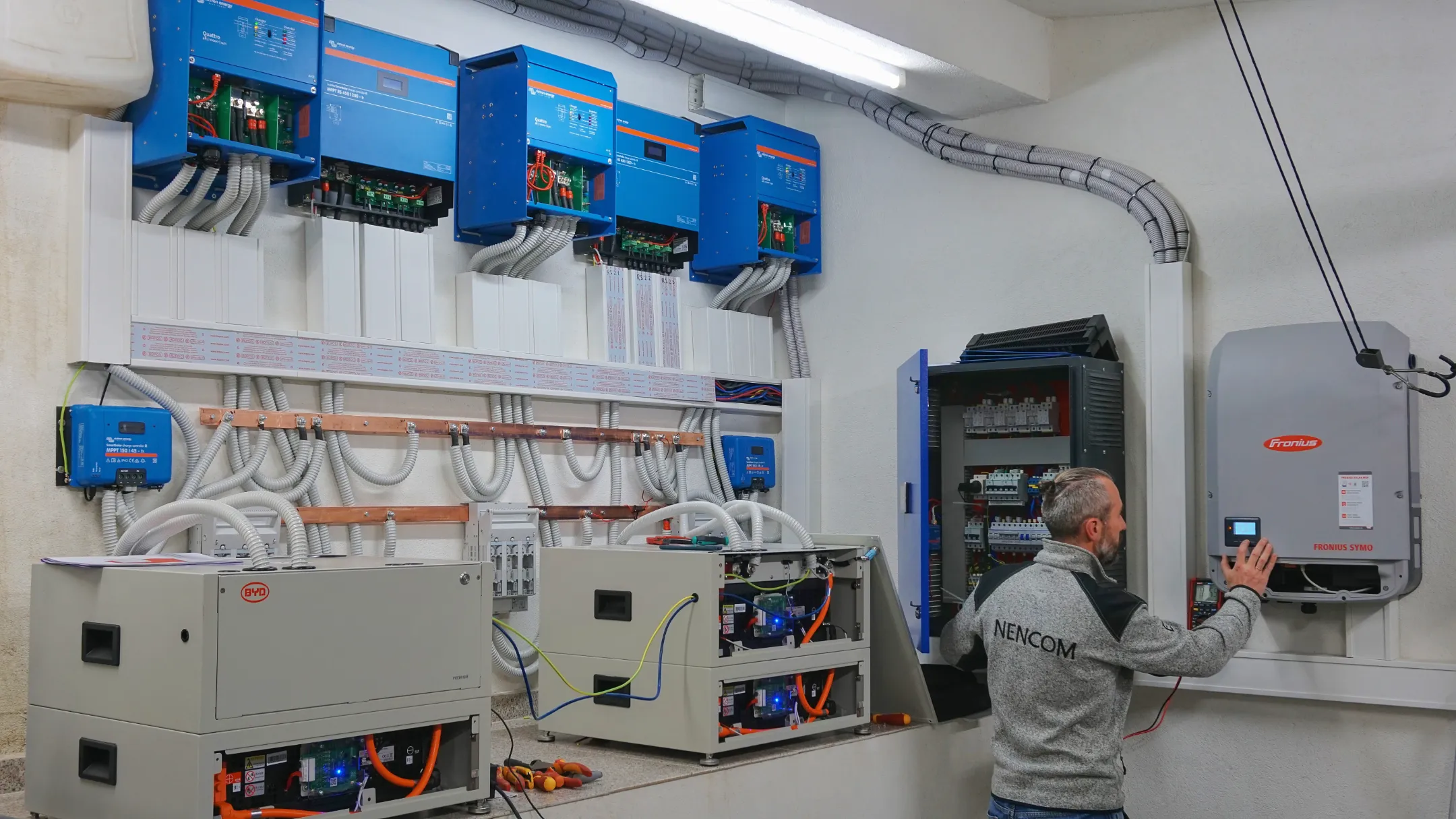
A convenient opportunity for testing came after another system had been assembled in our workshop, as there was still enough time before it was sent to the customer’s site.

Test system in the workshop
While preparing for the test, I installed an independent Victron SmartShunt measuring device between the battery and the inverter and discharged the battery with a steady current of about 55 A on the DC side.

Victron Energy SmartShunt
At that moment, I noticed something strange. Three different sources — SmartShunt, the inverter and the current clamp — showed stable and almost identical current values, while the battery management system (BMS) was transmitting jumping readings over the CAN bus: 52, 68, 43, 65 amperes...
BMS data jumps, SmartShunt is stable
A similar situation occurred while charging the battery with a steady current (the MultiPlus-II inverter has a built-in charger). The system was operating normally, without any errors, but the current data (and therefore the power data) from the BMS looked in the monitoring system as if the load was constantly changing:

Charging the battery with a current of ~32 A
I had to postpone the battery capacity test and start looking for the causes of this strange behaviour.
Diagnostics
My first assumption was a problem with the BMS board. If it processes the signal from the battery measuring shunt incorrectly, then the data on the CAN bus will also be wrong.
On Friday evening, I reported this to Kamen from Solar MD support, and by Saturday morning a courier had delivered a new BMS to me. I immediately replaced the board, and Kamen remotely activated it through the Solar MD logger. The battery started working, but the current jumps remained.
My second assumption was a problem with the measuring shunt inside the battery or with the wire from it to the BMS board. I removed the protective panel, checked the shunt, the wire and the contacts — everything looked normal.

Measuring shunt of the Solar MD battery
I measured the voltage drop with a multimeter both across the shunt itself (it should be proportional to the current flowing through the shunt) and between the contacts of the «Shunt» connector on the BMS. The readings were identical and stable, while the current data transmitted over the CAN bus kept changing.
I noticed that on the board, immediately after the shunt socket, there is an RC filter. It is probably intended for suppressing interference rather than averaging out such pulsations.

RC filter on the BMS board
Just in case, I made the wire between the shunt and the board into a twisted pair and routed it separately from the other conductors to rule out interference. Nothing changed.

Wire between the battery shunt and the BMS board
Before moving on to the next stage, I made several more checks and changed the power wiring to rule out the possible influence of the specific test setup.
Current pulsations on the DC side

Pulsating current on the DC side
In principle, this is normal. The inverter converts direct current (DC) into alternating (AC) at a frequency of 50 Hz. In each AC period there are two half-periods — positive and negative, and between them voltage and current pass through zero, although not always at the same time, depending on the nature of the load. Instantaneous power is equal to the product of voltage and current, so in a single-phase system it pulsates at twice the frequency.
The inverter transfers this pulsating power between the AC side and the battery. At the same time, the battery voltage remains relatively stable, while the current changes in waves at the same frequency — 100 Hz. The result is pulsating direct current.
❗It is important not to confuse current pulsation with voltage ripple on the DC bus. Pulsating current on the DC side of a single-phase inverter is normal in itself, while noticeable DC voltage fluctuation under load is already a problem that Victron calls «High DC ripple». It usually indicates insufficient conductor cross-section, a poor contact or another weak point in the power circuit.
The oscilloscope showed a similar picture on the Victron shunt as well. It looks like the inverter and SmartShunt correctly average the data, while the BMS transmits values close to instantaneous ones over the CAN bus, each time landing on different points of the sine wave.

The question arises: why do our other systems with Solar MD batteries not have this problem?
Comparison with other systems
ⓘ I checked all our installations, except the test one, through Victron Remote Management (VRM), without being able to connect a multi-tester, clamp meter or oscilloscope.
First, I set a steady charging current in a single-phase system with one SS4160 battery and a MultiPlus-II 5 kV·A inverter. Similar current fluctuations in the BMS data transmitted over the CAN bus were also present there, but they were less pronounced:

Orange lines — BMS data
The comparison is useful, but not entirely fair: in the test system, the inverter is twice as powerful — 10 kV·A. In addition, there was a local load at the site, the nature of which could have affected the amplitude of the pulsations. The BMS firmware in both batteries was the same — v214.
After that, I ran similar tests in three-phase installations with the configurations «two batteries + three 8 kV·A inverters» and «three batteries + three 10 kV·A inverters». In these systems, the current data from the BMS turned out to be significantly more stable.
This looks logical, since three-phase inverter systems work more smoothly with the direct-current bus. The pulsations of instantaneous power across the phases partially compensate each other, and the current on the DC side becomes significantly smoother. With a balanced load, the compensation becomes almost complete.
Overall, the comparison was again not entirely fair. I started looking among our systems for a configuration similar to the test one: «one SS4160 battery + one MultiPlus-II 10 kV·A inverter». It turned out that we had exactly one. I checked it and found that this installation had no problems with current jumps in the BMS data. At the same time, its only fundamental difference compared with the test system was the older firmware of the BMS board — v208.
A preliminary conclusion can be drawn that firmware v214 does not sufficiently average the values of the pulsating current on the DC side, transmitting values close to instantaneous ones over the CAN bus. In three-phase systems, this problem is masked naturally.
Result
I sent an email to the Solar MD engineers describing my test and asking them to compare the algorithms for averaging the measured voltage drop across the shunt in firmware versions v208 and v214. In their reply, they confirmed that the cause of this behaviour was indeed the new BMS firmware, and promised to consider changing the algorithm.
For me, this case is interesting because strange readings in the monitoring system do not always mean an equipment fault. Sometimes the cause lies in how the data is measured, processed and passed on. The battery has been operating at the client’s site for several months without any problems.

I am testing the system on site