
Victron Microgrid
Modular architecture
 Roman Rubanovich
Victron Energy offers a new «Microgrid» architecture for building and expanding off-grid systems.
Previously, for a small single-phase system, we used one MultiPlus or Quattro inverter/charger. For a three-phase system — three inverters, one per phase. If more power was required — we installed several inverters in parallel on each phase and connected them through the VE.Bus interface into a single synchronised system.
This approach has several limitations:
- The maximum continuous power of a single Victron off-grid system is currently 180 kV·A (around 144 kW) in a three-phase configuration and 75 kV·A (around 60 kW) — in a single-phase configuration.
- A system with a large number of inverters is technically complex and expensive. Parallel units require symmetrical AC and DC lines for even current distribution.
- All inverters in a single VE.Bus system must be of the same type and run the same firmware version. They operate with a common battery system, which limits equipment choices when expanding the system.
- Even identical models from different production revisions may differ in internal resistance, as may new inverters compared with units that have already been in service. This can result in uneven load sharing between parallel units.
- A large number of inverters, batteries, busbars and protective equipment requires a sufficiently spacious technical room. At an existing site, available space may be limited.
- Adding inverters to an operating system may require a complete redesign of the AC and DC sections if expansion was not planned during the initial design.
- All inverters within the VE.Bus system operate as a single unit. If one of them fails, the entire cluster will stop, even if the remaining inverters are fully operational.
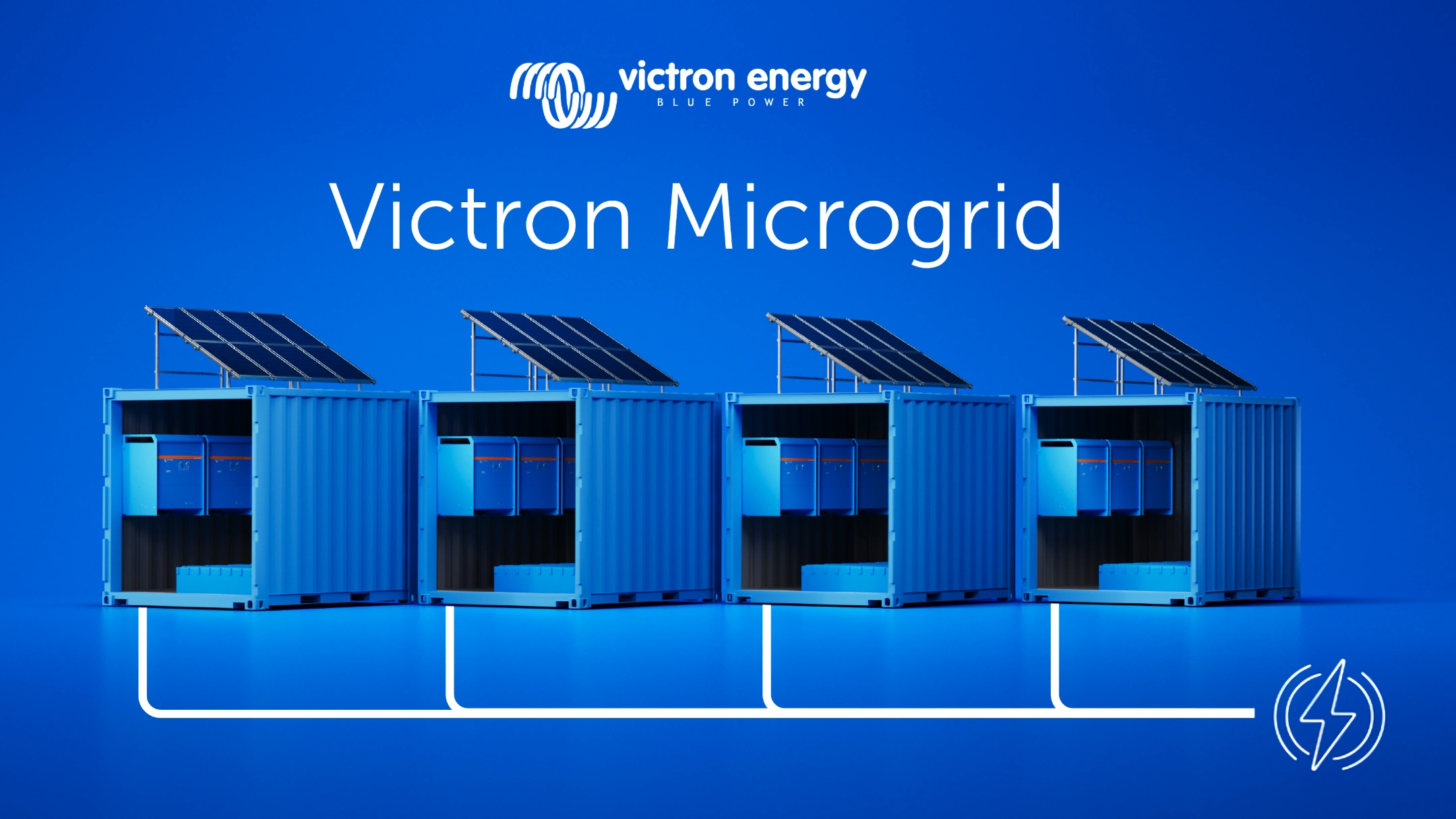
ⓘ The modular Microgrid architecture is now available, in which several separate off-grid systems operate in parallel on a common alternating-current bus.
Victron uses the term Power Bank for each such system. In this context, a Power Bank is a complete off-grid system comprising one or more inverter/chargers, its own battery, DC distribution and charging sources. Its own GX device may be used for monitoring and control.
Within a Power Bank, the standard Victron architecture is retained. The system can be single-phase or three-phase and include several parallel inverters on each phase.
But different Power Banks are not connected via VE.Bus and do not share a common DC bus. Therefore, they can differ in power, number of inverters, battery capacity and charging sources, as well as be located in different technical rooms or separate containers.

A separate communication line between them is not required for joint operation. It is sufficient to connect them to the common AC bus.
The load between different Power Banks is distributed automatically, without a central controller or data exchange. For this, Victron uses the Hybrid Droop algorithm — its implementation of the widely used droop control method.
As the active load increases, the frequency of the common AC bus decreases slightly, and each Power Bank increases its active power output (P-f Droop). Reactive power is distributed in a similar way through changes in voltage (Q-U Droop).

With identical settings, more powerful systems take on a proportionally larger share of the load. Small deviations in frequency and voltage are a normal part of the regulation process.
The main practical benefit of the new architecture is the ability to increase the power of an off-grid site in stages. A system already in operation can become the first Power Bank, with others added later. At present, Power Banks with a total power of to 400 kW can be combined in a single Microgrid.
Each Power Bank remains an independent system. It can be started separately, shut down for maintenance or replaced. If one Power Bank stops, the others will continue supplying the load as long as their total power and available energy are sufficient.
Such an architecture can be useful for remote sites, production facilities with off-grid power supply, farms, construction sites, festivals and concerts, as well as mobile containerised energy systems.
For example, an energy equipment rental company can combine different numbers of identical Power Bank containers depending on the required power.
Architecture specifics
The Microgrid architecture is intended only for off-grid operation. The common AC bus is formed by the Power Banks themselves so they can operate together and supply the loads. An external electrical grid, AC generator, grid-connected PV inverter or other AC sources cannot be connected directly to it.
Each Power Bank must have its own charging sources: MPPT controllers with DC-coupled PV, a DC generator, or a separate charger powered from an external grid or AC generator.
The SoC (State of Charge) of the batteries in individual Power Banks is not automatically equalised. Over time, its values will differ depending on PV array power and shading, battery capacity and condition, as well as other variable parameters.
If one Power Bank discharges before the others, it will disconnect from the common bus, and its load will be taken over by the remaining systems.
Victron recommends arranging the charging so that at least one Power Bank retains the ability to accept excess energy and does not reach full charge at the same time as the others.
If the batteries of all Power Banks are fully charged while the charging sources continue to produce energy, a constant load of at least 2% of the systems’ total nominal active power must be maintained on the AC bus. Otherwise, circulating power flows may occur between the Power Banks.
This requirement applies only during active charging, when the voltages of all batteries approach the Float voltage or exceed it. As long as the batteries are not fully charged, they absorb the excess energy themselves.
The connection scheme must also be taken into account:
❗If there are no parallel inverters on the same phase in a Power Bank, the common Microgrid bus is connected to AC-IN, and AC-OUT is not used.

For the Quattro model (with two alternating-current inputs), AC-IN-2 is used in this case.
If several inverters operate in parallel on the same phase, an External Transfer Switch is used, and the power connection is made through AC-OUT.
Summary
Microgrid is a separate way of building an off-grid system with its own rules for design, commissioning and protection.
In my view, the main value of Victron Microgrid lies not so much in increasing the maximum power up to 400 kW as in the ability to build large off-grid systems from independent modules.
Such a site can be expanded gradually, without combining all the equipment into one complex cluster or completely rebuilding the existing system. For a private house, this architecture is unnecessary in most cases, but for large, distributed and containerised off-grid sites it opens up new possibilities.
See also:

08.01.202612.01.2026
PV generation in snowfallToday after noon, winter arrived in Varna: it suddenly became dark and heavy snowfall began. I decided to check how things were in other ...

21.12.202529.05.2026
Current jumps in the batteryI had long been planning to check the real capacity of the SS4160 battery from Solar MD. Some potential buyers, looking at its ...